How Does Bihar Property Registration Work?
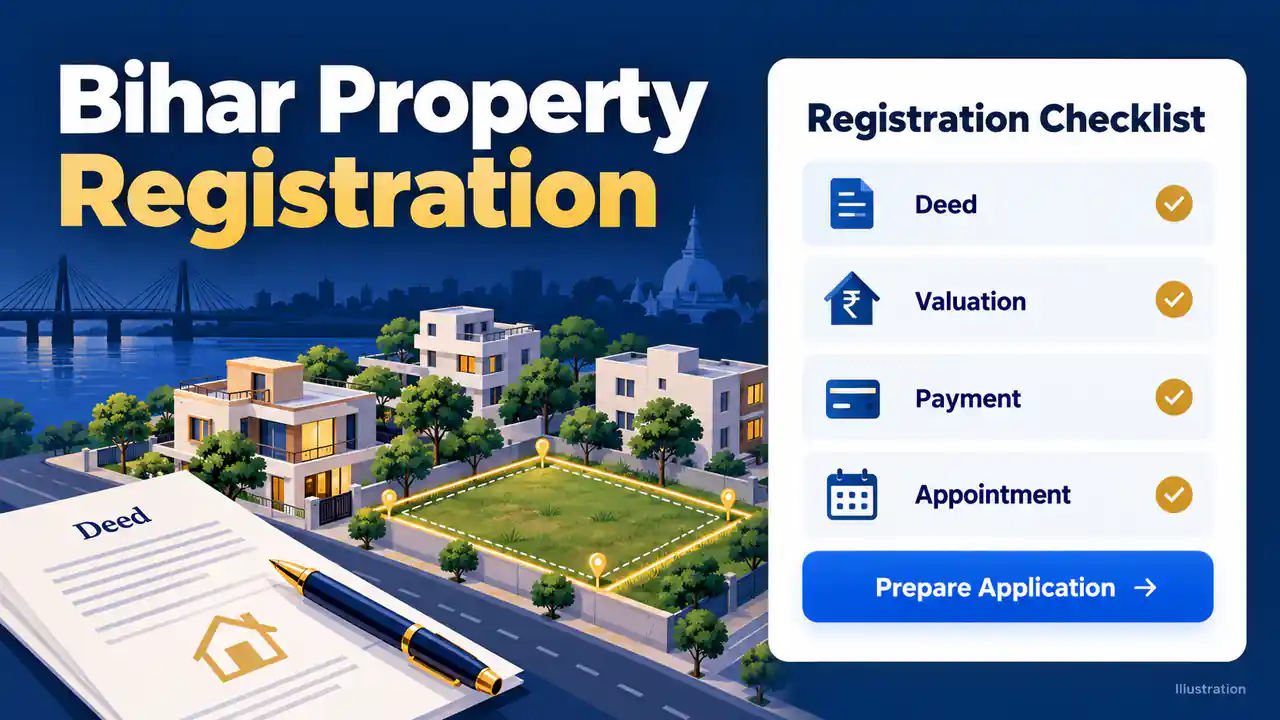
Use eNibandhan's Document Registration service for the application, then follow the instructions of the Sub-Registrar's Office (SRO) responsible for the property. Prepare and verify the deed before submitting details. Online filing, payment and booking are steps in the process; registration is completed through the registering authority's prescribed checks.
- Check the property and seller. Compare earlier deeds, land identifiers, recorded area and boundaries. Check any mortgage, restriction or unresolved discrepancy before committing to the transfer.
- Prepare the correct deed. Record the parties, transaction, consideration and property description accurately. A gift, lease or partition should not be filed as a sale merely to reuse a form.
- Open eNibandhan Bihar. Use Citizen Login and Document Registration. Select the office and supply the property, party and deed details requested.
- Review valuation and charges. Check the Minimum Value Register (MVR) category and area unit, then obtain the applicable stamp duty and registration-fee assessment.
- Pay and keep the references. Use the official payment route. Save the challan, e-stamp details and application acknowledgement; verify the payment status before proceeding.
- Follow the confirmed appointment. Take the deed, supporting papers and required parties or identifiers. Complete the identity, execution and other checks directed by the registering office.
- Collect and verify the registered record. Check the registration number, date, names and property schedule. Keep the issued document and receipts, then track any mutation application.
The Prohibition, Excise and Registration Department, Government of Bihar lists document registration, online payment, certified copies and application status on its portal. Follow the current form for authentication and upload requirements.
Which Official Portal Handles Bihar Property Registration?
Use eNibandhan for the registration workflow and its listed payment, status and certificate services. Bhumi Jankari holds available older registration records and valuation searches. BiharBhumi handles revenue services such as mutation and Jamabandi. Choose the portal by the task you need to complete, rather than treating these sites as interchangeable.
| Government portal | Use it for |
|---|---|
| eNibandhan | Registration application, online payment, application/challan status, certified copies and encumbrance-certificate services. |
| Bhumi Jankari | Available older registered documents, party-name and serial-number searches, land MVR and flat MVR. |
| BiharBhumi | Dakhil Kharij, mutation tracking, Jamabandi and other revenue-record services. |
Start from eNibandhan's service list for a new registration. For older deed searches, check Bhumi Jankari's record-period notice. For mutation or Jamabandi, use the Department of Revenue and Land Reforms, Government of Bihar portal.
Registered deed and revenue entry: what each records
Registration places the property instrument in the registration record. The registered deed can support later transactions and document review. Jamabandi records serve the revenue-record purpose. Compare both when checking a property: the registered transaction and the current revenue entry may need separate follow-up.
What Documents Should You Prepare for Property Registration in Bihar?
Prepare the deed, earlier title papers, precise property particulars, party identification and payment evidence. The final checklist depends on the deed and the people involved. Ask the registering office about special circumstances, including representation by an attorney, inheritance or an existing mortgage, before signing or booking the visit.
| Prepare | What to verify |
|---|---|
| Deed and earlier title papers | Draft the correct sale, gift or other instrument; check the seller’s authority and earlier document references. |
| Property identifiers | Match district, registration office, mauza, khata, khesra or plot number, area and boundaries across records. |
| Revenue and tax records | Compare available Jamabandi or Khatiyan entries, land-revenue receipts and property-tax details with the deed; confirm which supporting records your office requires. |
| Party and identifier details | Prepare the identity, address, photograph and authentication details requested for your transaction. |
| Valuation information | Use the applicable Minimum Value Register entry, property category, location and area unit. |
| Payment and application references | Keep the stamp or e-stamp proof, fee receipts, application acknowledgement and confirmed appointment. |
| Case-specific supporting papers | Ask about mortgage release, authority to act, inheritance, approvals or other documents relevant to this transfer. |
Prepare PAN and Aadhaar or other identity details where the applicable form requires them. Have witness or identifier particulars ready according to the office's instructions.
Keep legible scans and originals where required. Do not assume every case requires the same number of photographs or the same identity-document combination. A mismatch between the deed's property schedule and the revenue record needs clarification before submission.
How Can an Encumbrance Certificate Help Before a Purchase?
An Encumbrance Certificate (EC) helps you check recorded transactions or encumbrances for the property and search period covered. Read it alongside the registered deeds and property identifiers. Treat the result as one part of your review, because the search scope and underlying records determine what it can show.
eNibandhan lists an Encumbrance Certificate service. Follow its current form and check the property description and period on the issued result. A wrong parcel identifier or narrow period can make the record less useful for the purchase you are considering.
Review any mortgage entry with the corresponding release documents. Do not read an empty result as a guarantee against every dispute, unregistered claim or title defect. For a purchase, resolve inconsistent names, boundaries or earlier deed references before relying on the paperwork.
How Are Bihar Property Registration Fees and Stamp Duty Calculated?
Budget for stamp duty, registration fees and any additional charges separately. The assessed property value, deed category, location and parties affect the calculation. Obtain a current assessment before paying: a percentage table copied from an older guide can miss a rate revision, concession condition or municipal-area charge.
| Charge | What determines your amount |
|---|---|
| Stamp duty | The instrument, chargeable value and applicable concession determine this levy. |
| Registration fee | A separate charge; confirm the current fee entry for the deed and parties. |
| Additional duty / processing | Check municipal-area duty, processing, scanning or other heads shown in the assessment. |
| Professional and later costs | Deed drafting, title review, certified copies and mutation services are separate from the duty itself. |
Sale-deed stamp duty: check the notification date
Notification No. 4060, dated 18 June 2026, specifies 6.6% for a sale transfer from male to female and 7% in other cases. The department's Acts and Rules index lists that revision; the gazette text reproduced by BiharInfraTales gives the percentages. The concession describes the direction of transfer, not simply every woman buyer.
These are stamp-duty percentages, not an all-inclusive registration bill. Confirm the current registration-fee entry, additional duty and any exemption in the official assessment. Check a joint or institutional transfer with the office rather than averaging two individual rates.
A worked stamp-duty example
If the chargeable value is ₹40,00,000 and the applicable stamp duty is 7%, the duty component is ₹40,00,000 × 0.07 = ₹2,80,000. Registration fees and other applicable charges are added separately. This example assumes the value has already been assessed.
Municipal-area property can attract additional duty. The CAG's Bihar audit, chapter 5, footnote 15 documents a separate 2% municipal-area levy. Confirm its applicability and the payable total for your deed.
What Is MVR, and How Do You Check the Property Value?
The Minimum Value Register (MVR) provides the valuation reference for the property's location and category. Check the relevant land or flat entry, area and unit before calculating charges. A city-wide average or the seller's quoted price is not enough to identify the correct valuation for a particular parcel.
Bhumi Jankari lists View MVR and View Flat MVR. Match the registration office, locality and property category, then verify the applicable value in the current registration workflow. If the negotiated price is below the valuation reference, ask how the chargeable value is assessed; do not simply calculate duty on the lower figure.
How Do You Check the Application or Challan Status?
Open eNibandhan's Application/Challan Status service and choose the relevant application type. Enter the application number and registration office, then complete the displayed verification. Match the returned result to your acknowledgement. A successful payment indicates a payment outcome; it does not by itself establish that the deed has been registered.
The official status form requests these identifiers. If a debit is missing from the result, retain the transaction reference and contact support before making a second payment. For an objection or incomplete application, follow the office's instructions using the same application reference.
Where Can You Search Bihar Registration Details and Download a Deed Copy?
Use the portal that holds records for your registration period. Bhumi Jankari's notice says its registered-document data is available up to 15 December 2024 and directs later-document requests to eNibandhan's certified-copy module. Keep the office, deed number and year ready; a new record missing from the older portal may be on the newer service.
- Older registered documents: open Bhumi Jankari. It lists advance, party-name and serial-number searches. Use the filters offered for the available record period.
- Later records and certified copies: use eNibandhan's Certified Copy service and follow its application, payment and download requirements.
- Saving a PDF: use the issued download where offered. A screenshot or browser-printed search result is not automatically the certified copy required by a lender or another office.
Compare the names, registration particulars and full property schedule. An indexed entry is a starting point; examine the underlying deed and earlier title papers when reviewing a purchase.
What Should You Do About Dakhil Kharij After Registration?
Dakhil Kharij is the revenue mutation process used to update the land-record entry after a transfer. Check whether an application was generated or whether you need to apply, then follow its status. Registration and revenue-record updating have different outcomes; do not assume a new registered deed guarantees an immediately corrected Jamabandi.
The Department of Revenue and Land Reforms' BiharBhumi portal provides mutation applications, status checks and Jamabandi viewing. Match the resulting entry with the deed. If the holder, area or plot details are wrong, take the acknowledgement and supporting documents to the relevant Circle Office.
Avoid These Registration Delays and Record Errors
- Different names or parcel details: reconcile identity spelling, khata, khesra, area and boundaries before submitting.
- Wrong fee assumptions: check the current notification, deed type, concession conditions and all payable heads.
- Payment without confirmation: check the challan and appointment status; keep the receipt attached to the application record.
- Late presentation: section 23 of the Registration Act, 1908 generally requires documents other than wills to be presented within four months of execution, subject to statutory exceptions. Seek office guidance promptly if that period may expire.
- Assuming clear title: neither registration nor a clean EC cures every title defect. Compare the transfer chain, restrictions and relevant records before relying on the seller's claim.
For portal help, eNibandhan publishes 14544 / 0612-3522300. Keep the office and application reference ready. Ask for the specific notification if claiming an exemption.
Frequently Asked Questions
Is Aadhaar mandatory for Bihar property registration?
Check the current eNibandhan requirements for your transaction and the registering office’s instructions. Aadhaar authentication may form part of the workflow, but an older article is not enough to establish every exception. If authentication fails or a party lacks the required credential, ask the office about the permitted procedure before booking.
How can you find a Bihar deed using a party's name?
Bhumi Jankari lists a party-name search for its available older records. Narrow the search with the office, year and property details, because a matching name can belong to someone else. For later documents, use eNibandhan’s certified-copy service and follow the identifiers requested by that module.
Can Bihar property registration be completed entirely online?
Online services let you prepare an application, make payments and track records. Completing those steps does not itself register the deed. Follow the office’s current requirements for presentation, identity checks and execution. Do not treat a payment receipt or booked slot as evidence that the transaction has been registered.
Are gift deeds, inherited property and joint purchases charged the same?
The instrument and transaction circumstances matter. A sale, gift, lease, partition or inheritance-related document can follow different rules. Do not assume a family transfer is automatically free or apply a single-buyer concession to a joint deed. Ask for the specific duty and fee provision used in your assessment.
How long should you allow for the registration process?
There is no single completion time for every transaction. Document readiness, office availability, payment confirmation and objections can affect the process. Use the confirmed appointment and application status as your references. Ask the registration office about any pending step instead of relying on an advertised same-day guarantee.
Is there an official Bihar property registration app?
The government web portals provide the verified starting points in this guide. For an app, follow a current link published by the department and check its developer before entering identity or payment details. A similar name or government-looking icon alone does not establish that an app is officially authorised.