How to Check Old Owner Land Records Tamil Nadu Online
Begin with the property's identifiers. Keep the district, taluk, village, survey number and subdivision ready. For town-survey land, use the town, ward, block and Town Survey Number. An owner's name helps comparison, but property details keep the search attached to the correct parcel.
- Open Tamil Nadu e-Services and choose the Patta / Chitta, A-Register or TSLR service.
- Select the location and enter the identifiers requested by that form.
- Complete the verification shown, then compare the holder, extent and classification with your deed.
The district government service directory lists these services. Follow the live form for verification requirements.
Which Records Help Trace a Previous Owner?
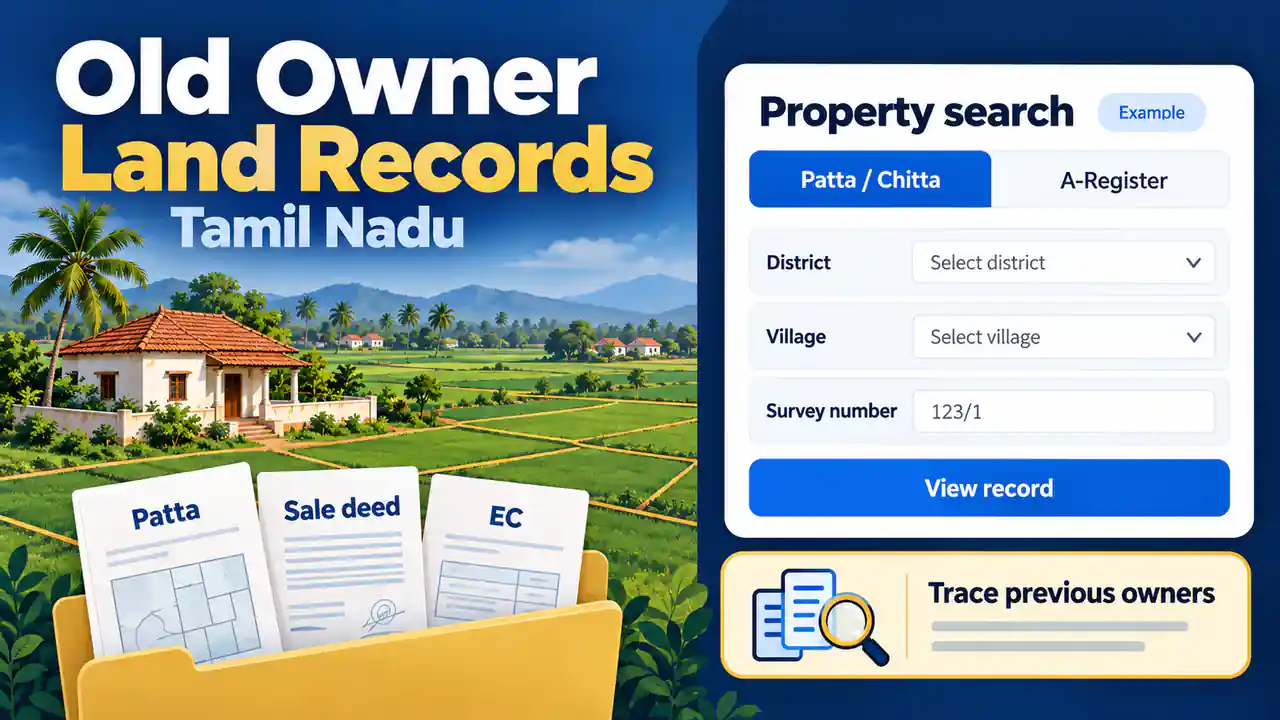
Use Patta and A-Register for revenue entries, TSLR for town-survey land, registered deeds for transfers, EC for dealings and FMB for measurements. “Old owner land records” covers these documents, rather than one certificate. For purchase or inheritance checks, compare the parcel across documents.
| Record | What to compare |
|---|---|
| Patta / Chitta | Recorded holder, survey subdivision and extent. |
| A-Register | Village revenue details, classification and assessment. |
| TSLR extract | Town Survey Land Register details for urban land. |
| Registered deed + EC | Transfer documents and indexed registered dealings for the searched period. |
| FMB sketch | Field Measurement Book boundaries and measurements. |
Revenue entries alone do not confer title, as the Supreme Court explains in paragraph 8.2. Read the transfer documents alongside them.
How Do You Find the Previous Owner Through Deeds and EC?
Start with the latest available deed and note the earlier document references. Obtain those deeds and compare their parties, dates, extent and boundaries. Use an EC for the relevant period to locate registered dealings, then examine the underlying documents. An EC entry is a lead, not a complete title assessment.
Use TNREGINET or the Sub-Registrar Office (SRO) for registration records. The Tamil Nadu e-Governance Agency (TNeGA) lists EC and certified-copy services. Our EC View guide explains the search.
Where to Request Missing Old Patta and Historical Records
Ask the Village Administrative Officer (VAO) or Taluk revenue office which record holds the entry for your period. Specify the village, survey number, year range and document needed. For older settlement material, ask whether an Old Settlement Register (OSR), Re-Settlement Register (RSR) or Updating Registry Scheme (UDR) record survives and where it is held.
For ancestral land, bring family deeds and Patta copies. Request the pages or certified extract, keep the receipt, and confirm availability and charges before paying.
Save a Patta Chitta PDF and Verify the Copy
Use Download or Print where provided, or browser Print → Save as PDF. Keep the full record, reference number and retrieval date. Use the portal's verification service where available. A saved screen is not automatically a certified historical copy; ask the receiving office which format it accepts.
An office or lender may require certified versions. See the Patta Chitta guide for current extracts. Buying in Bihar instead? Read the Bihar property registration guide.
Old Survey Numbers, Missing Entries and Name Mismatches
- Old number not found: ask for the old-to-new survey correlation; do not guess subdivisions. For example, Tiruppur publishes town re-survey statements.
- Boundary mismatch: compare the deed with the FMB sketch and request clarification.
- Old name remains: check Patta transfer status. The Commissionerate of Land Administration describes the transfer-of-registry process.
Frequently Asked Questions
Does online Patta show all previous owners?
Do not expect a current Patta to contain the ownership chain. It shows the revenue entry for that property. Trace earlier holders through registered deeds, EC entries and historical revenue records, comparing the property identifiers and dates across each document.
Can I search old owner land records by name alone?
A name alone is an unreliable starting point because people can share it. Locate the village, survey number and subdivision from a deed, Patta or family document. For a missing registered deed, ask the relevant SRO what search details it needs.
Are Tamil Nadu old land records available free?
Start with the public online extracts before requesting a paid service. Charges for certified copies, archival reproduction or assisted services depend on the record and office. Ask for the official fee and receipt; do not assume every historical document is a free downloadable PDF.
Why does Patta still show the old owner after a sale?
Registration and revenue mutation are different processes, so first check whether a Patta transfer application was submitted and approved. Match the registered deed to the survey subdivision, then track the application. Ask the Tahsildar about a mismatch instead of treating the old name as a complete history.
How far back can I trace the owners of a property?
The Encumbrance Certificate can show registered transactions for the period you request, so ask for a longer period to see earlier deeds. Older history may sit in registered deeds, revenue registers or archives. Start from the latest deed and follow the recitals backwards, one document at a time.
Which office holds old land records?
Registered deeds are held by the Sub-Registrar Office where they were registered, while revenue registers sit with the village, taluk or district revenue office. Take the survey number, village and any deed numbers you have, and ask each office what it can search or issue.