What Is the Difference Between Patta and Chitta?
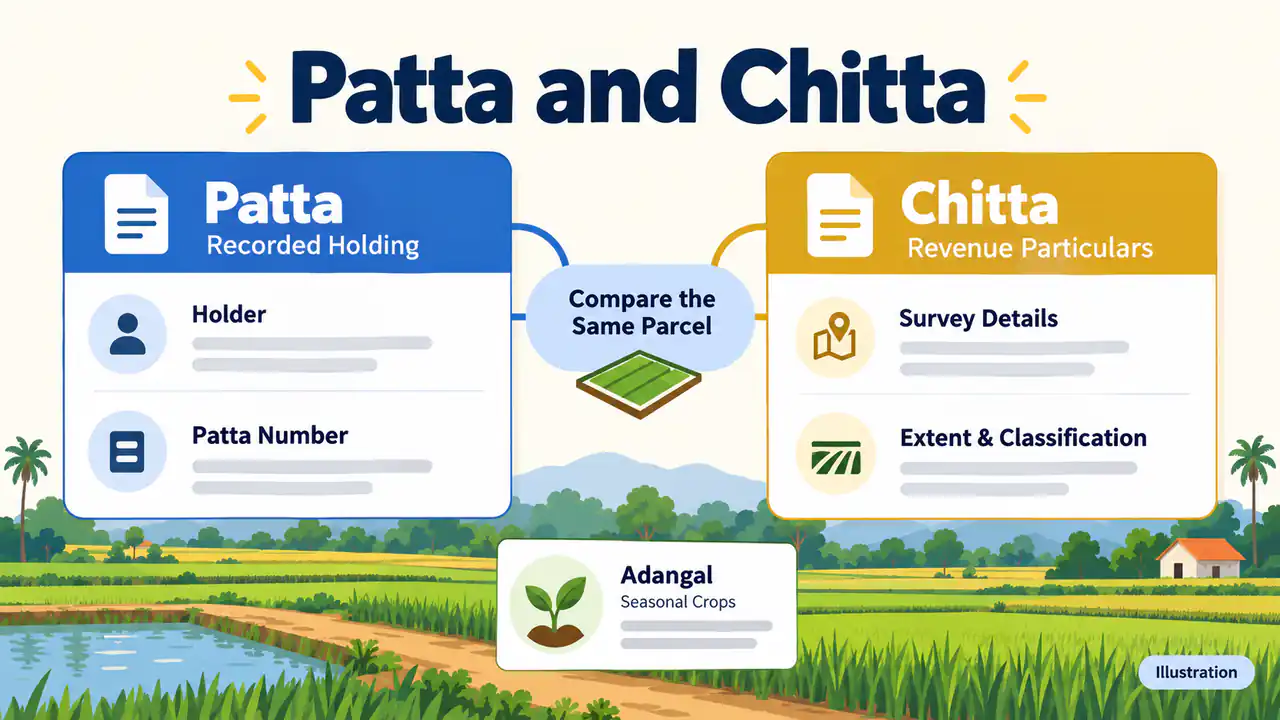
Patta connects a recorded holder with a landholding and its parcel particulars. Chitta is a revenue extract that can show the pattadar, Patta number and survey details, alongside relevant land particulars. Both help you understand the recorded entry; neither should be read only by its label or substituted for another required document.
| Aspect | Patta | Chitta |
|---|---|---|
| Main emphasis | Recorded holder and holding | Revenue particulars of the holding |
| Compare | Name, Patta number and parcel | Survey/subdivision, extent and classification |
| Possible overlap | Survey and land particulars | Holder name and Patta number |
What Does a Patta Show?
A Patta is the record that ties a named holder to a specific landholding. A Patta copy generally carries the holder's name, the Patta number, the district, taluk and village, and the survey and subdivision numbers of the parcel, along with its extent. Use it when you need to confirm who is recorded against a holding and which parcel the entry refers to.
Exact fields differ with the service and the type of copy you obtain, so read the entries on your own copy instead of relying on a general list. If a joint Patta is issued, more than one name can appear against the same parcel.
What Does a Chitta Show?
A Chitta is the revenue extract for a holding. It is the record to read when you need the land's particulars: survey and subdivision number, extent, and the classification of the land, such as wet or dry, along with the assessment that applies. It usually lists the holder's name and Patta number too, which is why the two records are so often read together.
Because Chitta repeats holder details, it is a useful cross-check. If the name, Patta number or survey number on a Chitta does not match your Patta or sale documents, find out why before you rely on either.
Are Patta and Chitta the Same?
Patta and Chitta are related, but treating the words as identical can be misleading. A shared online service or combined extract may present overlapping information. Chitta can include the holder's name, so the claim that Patta shows ownership while Chitta shows only land type is incomplete.
The National Informatics Centre also describes an Integrated Land Record combining textual rights information, FMB maps and Chitta. Read the fields and service name on the copy you obtain.
What Do Patta and Chitta Mean in Tamil?
Patta is written as பட்டா and Chitta as சிட்டா. In this land-record context, Patta refers to the recorded holding and holder, while Chitta refers to the holding's revenue particulars. These Tamil names identify the records; interpreting them does not require treating either word as a conclusive ownership certificate.
What Is Patta Chitta Adangal?
Patta, Chitta and Adangal are related land records with different purposes. Adangal focuses on agricultural activity: seasonal crops, yield and irrigation information. The Commissionerate of Revenue Administration and Disaster Management describes it as a village register maintained by Village Administrative Officers. It is useful for cultivation details, rather than replacing the holding record.
Which Record Should You Check First?
The right record depends on what you are trying to settle:
- Confirming the recorded holder: start with the Patta, then compare the name and Patta number on the Chitta.
- Checking extent and land type: read the Chitta, and match the survey number against the FMB sketch where boundaries matter.
- Buying land: compare Patta, Chitta and the Encumbrance Certificate with the sale deed and the earlier title documents.
- Checking crops and cultivation: ask for the Adangal, which records what is actually grown.
- Applying for a bank loan: lenders usually ask for current Patta and Chitta copies, so keep both ready.
Common Mistakes When Reading These Records
- Treating a Patta as proof of title. It is a revenue record, and it can be rebutted. Sale deeds and the chain of earlier documents decide ownership.
- Assuming Patta and Chitta always list different things. Their contents overlap, so check the fields instead of the name of the document.
- Searching with the wrong survey number. Parcels are often subdivided, so use the full number with the subdivision, such as 123/4A, and not only the main number.
- Using an old copy. Entries change after a sale, partition or inheritance, so download a fresh extract before any transaction.
- Confusing a transfer application with viewing a record. Viewing an extract does not change the entry.
Choose the Right Next Step
To view or download a record, follow our Patta Chitta online guide. For a revenue-entry change, use the transfer guide. Viewing an existing extract and applying to change it are different tasks.
Frequently Asked Questions
What Is Patta Chitta?
Patta Chitta is the familiar combined label people use when referring to these related Tamil Nadu revenue records. It does not mean every holding has two wholly separate online certificates. Check which extract the service returns, the parcel it identifies and the particulars it contains before requesting another document.
Does a Patta Entry Alone Settle a Title Dispute?
Do not treat a Patta entry as an unchallengeable answer to a title dispute. Under the Tamil Nadu Patta Pass Book Act, 1983, qualifying entries carry a rebuttable evidentiary presumption. The Supreme Court explains that disputed ownership may require a civil court's determination. Compare the revenue record with the title documents.
Which Is More Important, Patta or Chitta?
Neither replaces the other. Patta is the usual starting point for confirming the recorded holder, while Chitta is the better place to read land particulars such as survey number, extent and classification. For a purchase or a loan, check both against your title documents.
Can the Name on Patta and Chitta Be Different?
It can happen, for example after a sale, partition or inheritance if one entry was updated before the other, or because of a spelling error. If the two records disagree, ask the village or taluk revenue office to correct the entry before you proceed with any transaction.
Is Chitta the Same as the A-Register?
They are related but not identical. The A-Register is the village-level register of land holdings from which holding particulars are drawn, while the Chitta is the extract you view or download for a particular holding. The wording on a service can vary, so read the fields on the copy you obtain.
Do I Need Both Patta and Chitta to Buy Land?
It is sensible to check both. Patta shows who is recorded against the holding, and Chitta shows the survey details, extent and classification. Compare them with the sale deed, the Encumbrance Certificate and the FMB sketch before you pay an advance.